
Unlike my first two posts on this website, which are more about discussing ideas, I thought I should, this time around, tell you a story, and what better story is there to tell than the story of the first time I handled a beating heart.
I specifically and intentionally mention the common word ‘beating’ because it was not my first time handling a human heart in my hands. Ask any medical student from Walter Sisulu University, where I recently acquired my MBChB (Bachelor in Medicine and bachelor in Surgery) degree and they will tell you that dissection of Cadavers starts as early as first year in anatomy class. Therefore, the first time I handled a human heart was in sophomore year of medical school during the cardiovascular block. The difference this time around was that, it was ACTUALLY PUMPING BLOOD in a living person!

Some already know that I am currently doing my internship at Helen Joseph hospital in Johannesburg, South Africa. Currently (at the time of writing this post), I am rotating in General Surgery. Our system in South Africa is similar to the UK’s in that we rotate in different specialties as interns, analogous to a foundation year doctor in the UK. The US uses a similar term “intern” but do something a little different from us.
The current system at Helen Joseph hospital is that when you are on call as a surgical intern, you are either doing a SERA call, ward call or Emergency department (ED) call. On SERA call you see patients that are referred by the ED team to Surgery. As ward call, you cover all surgical wards, see red flags (critical patients handed over by day team for monitoring at night), put up Intravenous lines on patients and other procedures, are called for resuscitations as well as cover emergency theatre cases with the Surgical Registrar on call. In Emergency department calls you see patients as they enter the hospital, give immediate treatment and either discharge them home or send them to the appropriate department for further management.
On this particular night I was on ward call. It was already after midnight sometime in the AMs and my ringtone was already the worst sound I could possibly hear as I had been hearing it incessantly the entire night. “How long till day break?” was the daunting question on my head as I hadn’t even brought some food with me that night and hunger was playing games on me.
Just when I was running a blood gas on the machine at casualty ground floor, thinking of the lengthy path I’ll have to take back to the 6th floor, the paramedics came in rushing with a patient on a stretcher. The patient was handed over to the ED team and immediately the surgical registrar on call, Dr Jassat was informed. Luckily she was seeing a patient on the bed just next to that one in the Resuscitation area.
This entire scene was not very surprising as you can imagine, we were after all in a hospital. I continued to run my gas, minding my own business, knowing very well that there are 20+ doctors in that ED, way more experienced than an intern with only 4 months experience as a doctor, therefore that patient was more than safe. A minute or so later I was alarmed when I saw Dr Jassat literally running to theatre and almost the entire ED team around the patient, if you’ve seen Greys anatomy. It was not my first time on call with her and we had had emergency cases before, acute abdomens, bowel obstructions, incarcerated ischaemic hernias and the like but I had never seen her run to theatre. I must mention that I’m actually quite grateful to have worked with her as she is quite an incredible registrar who likes teaching and is just an overall nice person.
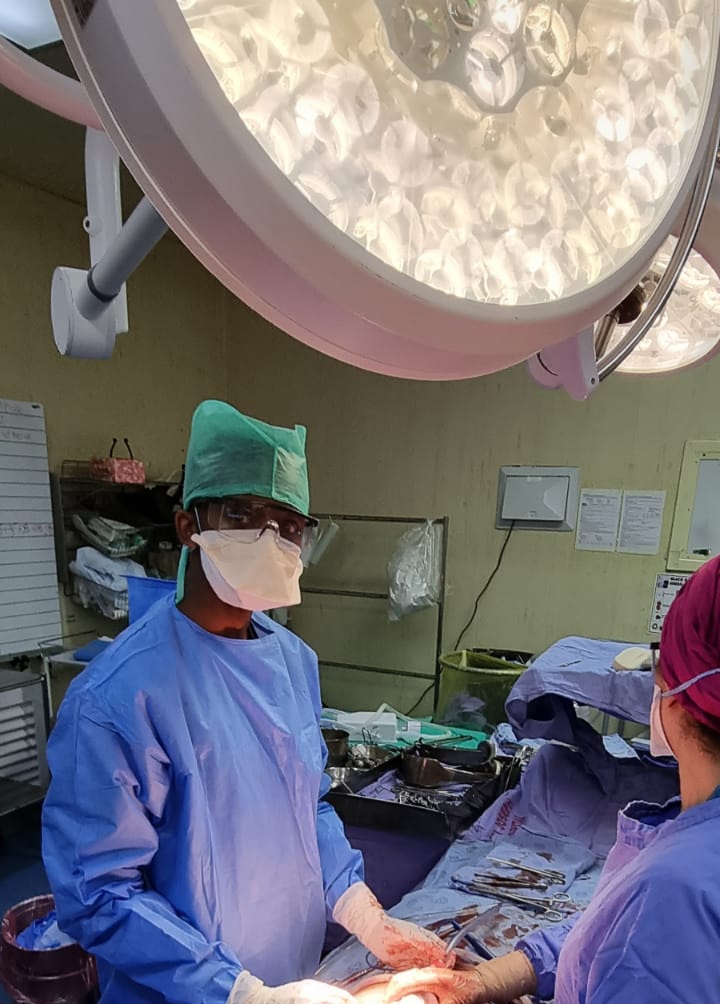
On with story, my friend and colleague, Dr Barnard was also nearby so I asked her, “Hey Andy, what’s happening?” “There’s a guy with a stab heart that was just brought in”, she replied. That moment I had a flash back of the one time I saw a stab heart case as a student doing my 4th year in medical school. 2 registrars and a consultant were doing the case but today there’s one registrar and a ward… “Wait a munite, I’m the ward call today!”, it clicked. That moment I quickly made my way to theatre. On arrival, the theatre was packed with ED doctors, anaesthetists and nurses. My Registrar was giving orders on what should be happening and was about to scrub. When I entered the theatre she only said one word, “Scrub!”. That very moment I quickly scrubbed and put on sterile garments. She also scrubbed and we proceeded to the table. The scrub nurse and the anaesthetist were also ready. Patient was already cleaned and draped.
“Sternal saw please”, She requested. Trying to assemble the different parts of the saw and connecting the machine, the scrub nurse realised that the saw is not working. This is an instrument used to open the sternum which is the bone on the front part of the chest. The alternative to that is a lebsche knife, which is a more “ancient” method to start a sternotomy. The lebsche knife happened to be in the sternotomy set. The big doctor called for it and the mallet, positioned the knife and started hitting. It seemed as though the knife was not sharp enough and thus more pounding was needed. As expected, fatigue began to set in because much effort is required with this older method of opening.
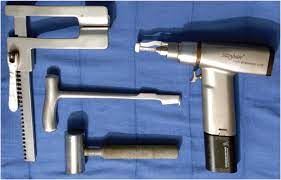
Realising this, I requested that I take over this part of the operation. Obviously as a senior she started instructing, “hold the lebsche upright and hit in that direction.” In my head I knew, if anything were to go wrong in the surgery, it would not be this part of the surgery. A hammer to a nail was not a foreign concept to me, from as far back as I can remember. A lebsche knife therefore was way bigger than a nail for me to miss or mess up. I started hitting and within no time, the chest was open.
Opening the mediastinum, one could barely see the heart because blood started squirting out. My senior called for a suture and we started suturing, and soon enough, the heart was closed. An inspection of the entire heart confirmed that there weren’t any other injuries to the heart. I could see the coronary vessels just like in anatomy class, textbook and some very few surgeries I’d seen before, difference now is that I felt the contractility on my hand with no obscuring skin and bone. More importantly, the patient was holding blood pressures and was okay.
At this point the consultant walked in and it was a proud moment for the team. We closed the chest, and by this, I close the story of the first time I handled an actual pumping human heart for the first time.
To surgeons, more especially cardio-thoracic surgeons, this is a thing they do. To some of us, these moments are priceless. Thank you for reading through.
 Timwritings
Great story and great job Dr Tim👏🏽you are an inspiration to many. Our lives are most definitely in good hands.
God bless you.
LikeLiked by 1 person
I think its amazing that Doctors do. Great story
LikeLiked by 1 person
one word LOVE LOVE LOVE….it’s 7:20am on Wednesday 26th of June 2024…I have no words to describe, literally felt like I am watching this in the other room through a window ,OR is downstairs but I can see everything🙈(in Xhosa we say umfanekiso qondweni) I think😊
LikeLiked by 1 person